FILM BROUGHT TO YOU BY COMING ATTRACTIONS (NOTES FROM THE JOURNAL OF CINEMATIC ANTICIPATION, VOL. 1)
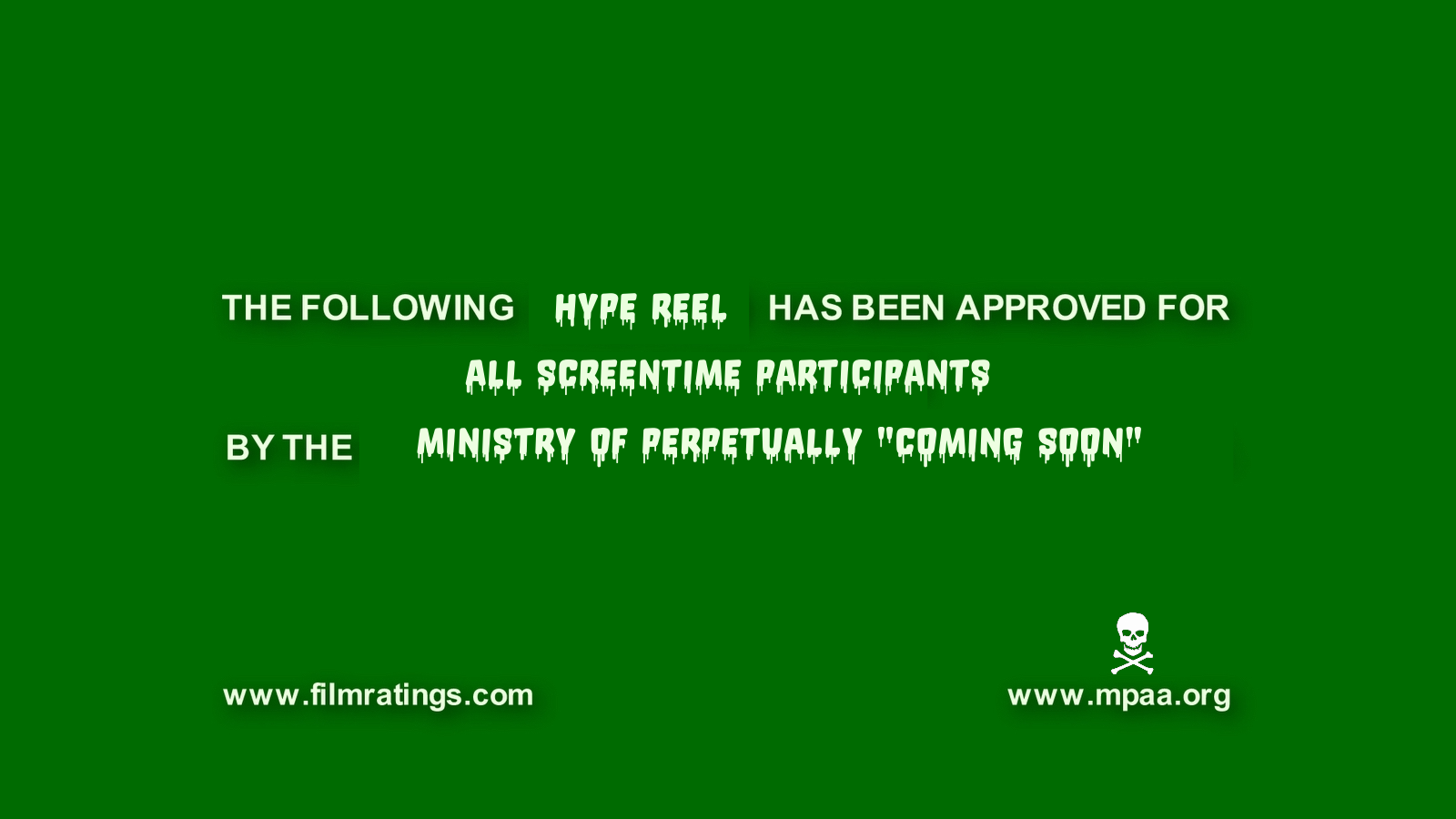
The lights don’t go down anymore.
These days, a movie starts, but then it never stops starting. Every scene promises a better one coming next. It’s two hours of cinematic foreplay—plot points teased, arcs hinted at, meaning perpetually deferred.
Films don’t really tell stories anymore, they tease them.
When I was writing about the death of MTV recently, I kept thinking—and my point ultimately was—about how its language didn’t die with it. It just got … promoted, I guess, for lack of a better word.
In any case, what MTV did for television, movie trailers are now doing for film: Teaching it to live in preview.
Every modern blockbuster now behaves like a hype reel. It’s a film about a franchise about a feeling about some merchandising. Avengers: Endgame spent half its runtime setting up things that never actually happen. Barbie opened like a TikTok reaction video, and closed like a TED Talk. Even Oppenheimer, Nolan’s three-hour prestige sermon on physics (and guilt), moves like an IMAX trailer for itself. Score pounding, dialogue clipped mid-breath, emotion rendered in explosions.
It’s not that these films lack craft—do not mistake me there. Because they pulse with it, in fact. But it’s a rhythm that’s no longer narrative. It’s neurological, and they play our brains like a drum. The trailer used to be a commercial for a movie, now the movie is the commercial for a trailer for the next movie. Every edit is an appeal to attention, every shot composed for potential virality, and you can feel the invisible algorithm breathing over the director’s shoulder, whispering, ‘Faster.’
This is an age of escalation without arrival.
What started as film language has become a survival tactic. MTV understood before anyone else that attention isn’t something you earn, it’s something you interrupt (you’re welcome social media). Nowadays, modern cinema has inherited the doctrine and stretched it to feature length. Where movies once gave us catharsis, they now manage our dopamine, the screen no longer asking for patience, but simply rewarding the act of sticking around. You can see it in the pacing: the premature climax hits at minute 40, then five finales, then a mid-credits stinger that invalidates the ending you just watched.
But somewhere in there is an echo of narrative gasping for air. You can hear it between beats, pleading for a longer shot, a full thought, a moment to land.
Unfortunately, breathing doesn’t test very well.
THE DEATH OF CLOSURE
So the thesis here is trailers used to sell movies, now movies sell trailers—and ok ok, sure, you say, whatever, word salad, but, no wait, listen, here’s what I mean: Once marking the onset of closure, end credits now promise that the story will continue (preferably in another medium / subscription tier / cinematic universe), making it narrative … but only for franchise capital (i.e. the cliffhanger is the business model).
You can trace some of this back to post-credit scenes, that little MCU flourish that mutated into a religion of perpetual ‘next time on…’ When Iron Man teased Avengers, it rewired our entertainment cortex, and suddenly, the point of any ending was to preview a future.
So, in this way, a modern blockbuster doesn’t resolve. It reloads. Characters die but contract negotiations don’t (read: RDJ’s return as Dr. Doom). The moral arc bends toward marketing. Check it: Fast X ends mid-explosion, Mission: Impossible stops mid-climb, and Dune literally fades to black halfway through a sentence. Every film now contains a placeholder for an as-of-yet-unrendered moment; a narrative deposit for an idea we might never get to collect—or just forget entirely.
What we’ve done is confuse anticipation with meaning. The trailer made that swap long ago, promise over presence, and now that thirty seconds of setup is the emotional core. Watching the actual film feels redundant, like seeing spoilers in HD you already read online.
There’s a specific kind of emptiness that hits when the lights come up and you realize you just sat through 160 minutes of branding material, isn’t there?
THE PERPETUAL TEASE
Film editing is supposed to be invisible, but now it’s choreography—an attention-harvesting machine. The modern cut assumes you’ll look away, so it keeps shouting at you so you don’t, every camera move a panic attack rehearsed for your convenience. Doesn’t matter where on the cinema spectrum these movies fall. Killers of the Flower Moon plays like a trailer for Film Itself™ (three and a half hours of prestige edited like Marty is trying to outrun his impending irrelevance). Everything Everywhere All At Once feels like a YouTube playlist of itself. Spider-Verse looks like what happens when you feed adderall to After Effects.
The average shot length for a major studio movie has dropped below three seconds, averaging about two-and-a-half (not fact-checked). Scores and soundtracks swell, retreat, swell again, like a dopamine tide chart. ‘What happens next’ has replaced ‘what happens’ period, and it’s caused the audience to lean forward, not inward. An editor told me once, off the record, ‘Our job isn’t rhythm. It’s retention.’
He wasn’t off-base, I don’t think. Every film has to compete with your phone, the apps, the audience, snacks in the lobby, the world outside. Cinema has entered a hunger-games phase of attention. We’re trained to watch with one eye on the screen and one eye on our screens, gauging which moments will live longest on the Internet. A perfect frame isn’t an artistic triumph, it’s a marketing opportunity. The meme economy is sitting in the director’s chair.
And it’s not that audiences can’t handle slow movies, either. Studios are just terrified of them. Slowness implies risk, stillness implies trust, and both are poison to quarterly reports.
THE AUDIENCE AS TEST GROUP
The results is that when a trailer promises discovery, so the film delivers confirmation. We go in knowing the tone, the color palette, the plot. That isn’t ‘going to the movies’, that’s an A/B test for emotional response. And this is why we can’t have nice things!
This is also how we’ve ended up with ‘fan service’ as a genre—not storytelling but satisfaction management. It’s a feedback loop of applause for a script written to reward preexisting knowledge. You can walk into Doctor Strange 5 without seeing the first four, but you’ll spend the runtime being told it’s out of context. It’s like cinematic gatekeeping as a customer loyalty program.
Even independent films have started to mimic this. Compressed exposition, cold opens, festival-ready pull quotes built into dialogue. You can feel the pitch inside the art. Now, that’s not complacency on their part, so, again, don’t get me wrong—it’s survival. Filmmakers work in a market where attention is the only negotiable currency. They’re hustling for seconds of our focus in an economy where the scroll never stops, and we, the audience, are the problem.
THE RELIGION OF HYPE
In the streaming age, marketing is the movie. Or the movie is the marketing. Either way, the poster drops, the cast tweets (or Xs?), the discourse erupts, and by the time it hits theaters, we’ve already seen it. Studios learned that the pre-release window generates more engagement than the actual run, so we’re living in a perpetual pre-screening. Always arriving, never watching.
Remember when The Blair Witch Project was so scary because you didn’t know if it was real or not? That mystery drove people to theaters (and didn’t give them a resolution for the drive home). Now, since everything is already ‘known’ (sometimes as a way to even subvert a plot leak), the only thing left to fear is FOMO itself. It used to be that hype was spark, but now that’s the whole shabang. The Barbenheimer Weekend proved that: two unrelated films became one global storyline simply because the Internet willed it. We didn’t witness a double feature, we participated in a cultural LARP.
THE LAST LONG TAKE
But I’m not all down and downer here, because, every so often, something slips through; a film that lingers instead of launches (this from a cinephile who sticks to a strict kung-fu and/or zombie movie genre niche). But seriously: Past Lives holds a conversation for five unbroken minutes. Drive My Car stretched silence until it became suspense. The Zone of Interest refuses to cut away from horror, instead turning us into witnesses. These moments feel radical not because they defy convention, but because they remember it. They trust the frame. They assume you can still look without swiping.
That’s what cinema used to be. We weren’t supposed to consume movies like playlists, we were supposed to live inside them for a while.
But then, maybe the answer isn’t slower movies, maybe it’s quieter minds. Maybe we can’t have patience on screen until we have it off screen. If the trailer teaches us how to want, the film, when it works, should teach us how to wait.
CLOSING CREDITS
If MTV’s [very timely] death taught us anything, it’s that aesthetic doesn’t die, it just gets reincarnated (or chooses a new host body, whatever perspective you want to take). The network’s pulse lives in the trailer’s heartbeat; in the montage that refuses to fade.
So, sure, every movie is a trailer now, but that doesn’t mean the story’s over. Maybe the cut isn’t the crime, maybe it’s a confession. Maybe what we’re really watching, in every jump and fade, is a species learning to endure attention.
The screen goes black. A logo flashes. A tease for something you haven’t seen yet. You wait, out of habit. The lights stay down.
Somewhere in the dark, a voice says, ‘Coming soon.’
#JournalOfCinematicAnticipation #TheMinistryOfPerpetualComingSoon #ProceedingsOfTheAlgorithm #TrailerAsForm #AttentionEconomyAfterDark #RecursiveSpectacle #GonzoMediaTheory #OverthinkOrDieTrying