MTV IS DEAD (AGAIN) ((OR IS IT?))
#ContentNecromancy101
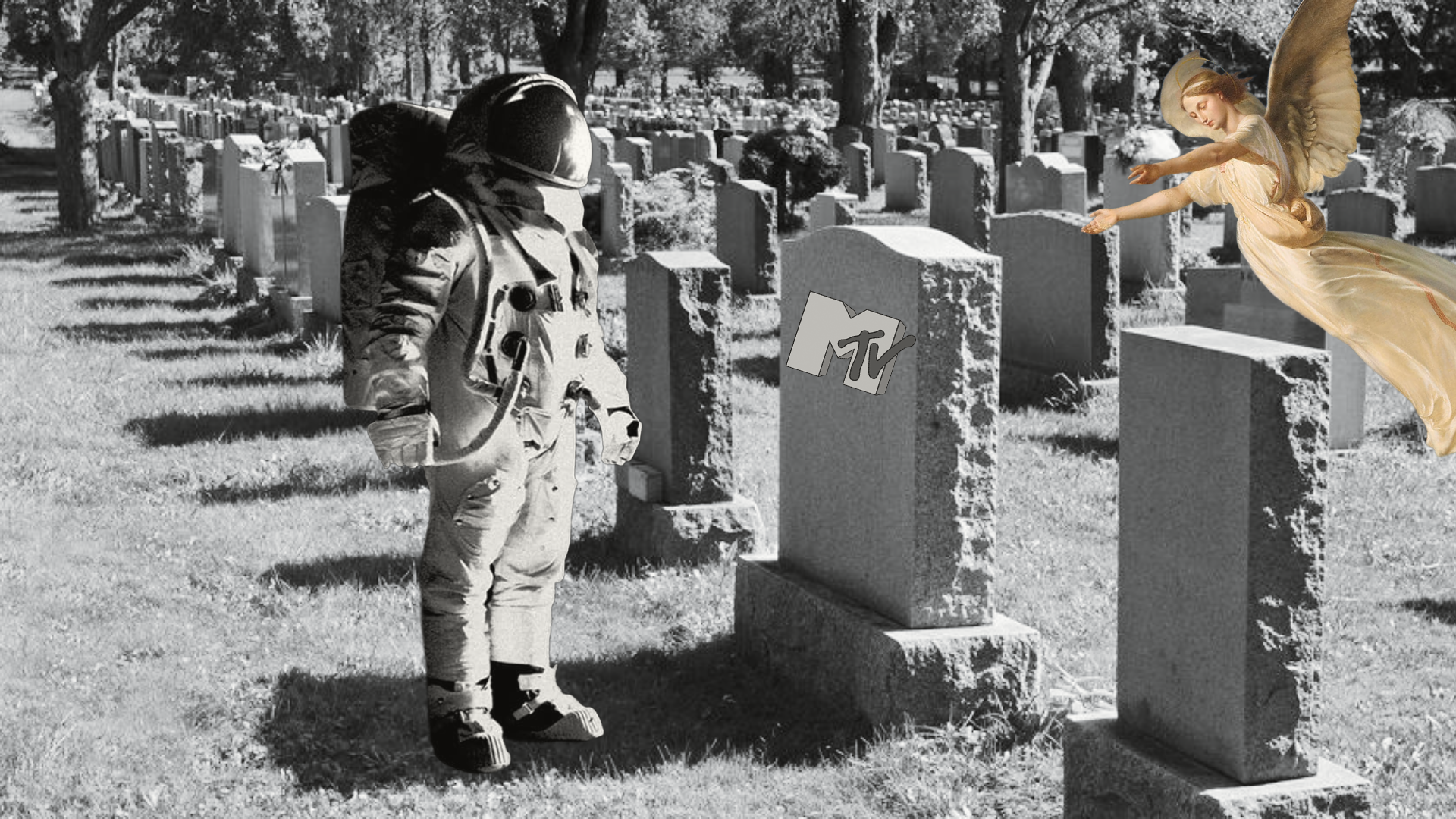
MTV has finally gone off the air after forty-four years.
No closing montage, no sentimental fade-out, no ironic callback to Video Killed the Radio Star. Just a line in a press release, a puff of recycled air in the algorithm, and the soft whirr of a thousand autoplay ads continuing on without it.
And honestly? Fair. MTV’s been on cultural life support for fifteen years. Its official death certificate just confirms what anyone with the appropriate cable subscription package already knows: The late-stage network was a programming zombie outbreak; an undead feedback loop of late-century nostalgia; a glow-in-the-dark reanimated corpse, once the epitome of cool that then sold that definition wholesale.
You can’t even be mad at it, though—it trained us too well. The brevity, the irony, the hyper-self-consciousness that passes for authenticity? MTV created all that. It didn’t get eaten by the Internet, it was the five-star chef that curated the menu. Every influencer currently recouping massive advertising dollars owes a royalty to The Real World. Every reaction video harvesting likes is just Total Request Live without Carson Daly pretending it’s live. Each and every TikTok dance craze is nothing more than a music video stripped for parts.
MTV isn’t dead, my Media Faithful. It’s just broken down, decayed, and slowly dissolved into our bloodstream.
#ProceedingsOfTheAlgorithm
Even so, the press release hit like a sick, wet thud on the back of the head, part jump-scare, part déjà vu: ‘MTV Ceases Broadcast After 44 Years’.
I think the reason it felt so Black Mirror is that there’s something about finality that feels improbable in the attention economy. Things aren’t supposed to end, they’re supposed to pivot to video. They’re supposed to relaunch, reboot, or go on hiatus until someone with venture capital resurrects them. But MTV? It just decided to stop showing up.
If you grew up anywhere between the Reagan Era and MySpace, MTV wasn’t TV, it was a weather pattern. You measured your adolescence in countdowns. You curated your personality based on whichever VJ you trusted most (Carson if you were safe, Sway if you needed cred, Kennedy if you hated yourself). It was never about liking music, it was about telling all your friends you knew which music to like.
MTV was the algorithm before algorithms had platforms.
And now? It’s gone. Officially. Finally. The first real channel signing off in a world where everyone is their own channel. There’s poetry to that. Ugly poetry, like a Limp Bizkit lyric carved into your tombstone. But poetry nonetheless.
#JournalOfCulturalForensics
The funniest part? The Internet won’t ever let it rest. Within minutes of the annoucnement, nostalgic think pieces began blooming like mold (*cough* *cough*). ‘The Death of MTV and the End of Cool’, ‘MTV: Gone But Not Forgotten’, ‘What the VMAs Taught Me About Vulnerability’. Everyone scrambling to write the obit before the body even cooled—
But that’s only because grief is emotional SEO.
Let’s be real about this: the last time MTV mattered was when The Antisemite Who Shall Not Be Named mic-rushed Taylor and stan culture was birthed, became sentient, and figured out how to weaponize a scandal. Everything since then has been a network looping on itself for a generation that aged out.
#StreamingAutopsyUnit
If you look at it closely, however, the ‘body' shows no obvious signs of trauma. Nothing more than a few years of branding fatigue and trace amounts of Axe Body Spray. Time of decline: 2003–2009. Year of death: 2025. Cause: success.
MTV overdosed on itself.
The infection started small: a reality-TV rash like The Real World: Las Vegas. Viewers loved it (finally, music with faces attached). Then came the onset of Cribs, which taught us all how to stage-manage our homes. Then, suddenly, the videos weren’t the fantasy anymore, the artists were, and at that point the camera turned in their direction and never turned back.
By the time TRL collapsed under the weight of its own product placement, the transformation was irreversible. MTV had discovered that reality was cheaper than art—edited, compressed, scored to pop-punk. One hour of Laguna Beach cost less than one Linkin Park video (and came with built-in cross-promotion). It was corporate evolution by natural selection.
From there, the virus spread through the system: from The Hills (soap opera playacting as diary) to Next (cattle call disguised as dating) to Teen Mom (daytime content cosplaying as morality drama) to Jersey Shore (just a Nietzschean abyss smothered in tanning oil). Each new series was yet another layer of callus over the channel’s heart (softly beating to the tune of Losing My Religion).
#RecursiveCoolSyndrome
By 2009, the network was no longer broadcasting youth culture, it was broadcasting the Act Of Trying To Televise Youth Culture. Meanwhile, YouTube was suddenly out there like some feral sub-species—same genes, no rules—reinventing the same idea for free. MTV’s decade-long brand workshop had taught a generation how to perform for the lens, and now everyone got to get their own. Kids didn’t stop watching music videos, they stopped needing permission to make their own music videos.
Don’t get me wrong, as an Elder Millennial it’s easy to say that ‘the Internet killed MTV’. But if you really think about it, that’s like blaming Frankenstein’s monster for killing Dr. Frankenstein. MTV built the operating system of modern attention.
Jump cuts? Their fault.
Confessional aside to camera? Patented it.
A sense that everything done might be content later? That’s just the MTV genome replicating itself in the wild.
#PostCablePathology
Even its death throes were televised. The VMAs turned into an annual ritual of public collapse—Britney, Adolf West, Miley—each one a sacrament in the Church of Meltdown. Ratings dipped, virality soared, and MTV learned that implosion guaranteed engagement.
During the 2010s, Ridiculousness became the network’s respirator. Twenty-four hours of people getting knocked out to laugh tracks. It was a perfect metaphor: the network platform reduced itself to sitting around watching other platforms’ content, like a snake eating its own bandwidth.
Of course, I’m not trying romanticize the pre-rot MTV age either. The same network that launched Nirvana also gave us Pimp My Ride, proof that even revolutionaries love chrome. The same channel that aired Unplugged also aired Jackass. It was always half-highbrow, half-head trauma, and that’s the genius that always made up for its commitment to entropy.
Now, here, under the lab light, on the autopsy table, you can see it all clearly: MTV didn’t die of neglect, it died of completion. It achieved total saturation. It taught every person, every brand, every media membrane how to act like MTV until the real one became redundant. The cadaver twitched a few times—nostalgia docuseries here, “retro” logo drop there—but it wasn’t a sign of life. It was a reflex; the body reacting to a synapse fire of memory.
#MillennialDecayStudies
There’s a moment for every generation when the soundtrack of its previous rebellion starts playing at Target. I hear ‘Smells Like Teen Spirit’ while I’m struggling out of a crouch in the deodorant aisle and I realize I’ve been drafted into the Adult Contemporary Army. That’s the exact frequency MTV’s death hummed at—a dial tone of people who thought they’d never age out of relevance.
Every social platform is MTV’s ghost haunting broadband. Everything faster, louder, edited for attention. The channel’s pacing was our baseline heart rate. MTV didn’t predict our behavior, it rewired it. We learned to live in segments; to chase moments we could portray as plot points; to treat intimacy as a broadcast opportunity.
Now, the organism that taught us how to live life as content has finally gone still, and we’re simply a commentary track. So when that headline dropped, we had already left the hospital room. MTV just stayed alive long enough to make its death a relief. And while the channel was bleeding out, we stayed busy co-opting its ideas. MTV Cribs is Instagram Stories. The Real World, YouTube confessionals. Jackass is just TikTok challenges with an episode outline.
We had not spent our lives watching MTV, we spent our lives internalizing it.
And since the modern feed has no end, we finally understand the trick MTV was playing. It wasn’t selling music or rebellion or attitude. It was selling loop. It was selling an eternal promise that something cooler was coming after the break; the idea that if you kept watching (kept scrolling, kept refreshing), the inherent meaning would return.
But it never did.
So when people ask why anyone should care that a cable channel finally flatlined, the answer is simple: because MTV is a mirror.
MTV is us.
#CulturalForensicsLab
Look around: every feed a rerun, every post a reboot, every thought formatted to trend. The culture didn’t fragment, it franchised. We’re all minor networks now, desperately syndicating ourselves.
To that extent, MTV didn’t die of obsolescence, it was a proof of concept that proved all too effective. And there’s your generational punchline: the network was never meant to last. It was designed to burn; to teach us to keep watching, then dissolve into everything else.
Yes, MTV’s gone—for real this time? Forty-four years of noise and makeup and accidental trend have come to an end.
But the feed will keep spinning. Louder, faster, thinner.
#AttentionEconomyAfterDark
If you listen hard enough, you can still hear it under the scroll, though—that faint Unplugged applause, that VHS hiss, that last gasp of collective cool before everything became ‘content’.
#ContentNecromancy101 #ProceedingsOfTheAlgorithm #JournalOfCulturalForensics #StreamingAutopsyUnit #RecursiveCoolSyndrome #PostCablePathology #MillennialDecayStudies #AttentionEconomyAfterDark #OverthinkOrDieTrying