THE MAGICAL SYNCHRONICITY OF BOB SEGER & MICHAEL JORDAN
THE EXPERIMENT (FOR ENTERTAINMENT PURPOSES ONLY)
Try this:
1.
Open YouTube—prefereably the app—and type ‘Michael Jordan highlight reel’. Obviously, it doesn’t matter which one, you’ll get hundreds: Career Mixtape (HD), The Shrug Game ‘92, Top 50 Plays of All Time. Every era, every rebound, every camera angle mankind could manage before HD. It’s like getting invited to pilfer the Library of Congress but all the books can dunk. Anyways.
Ideally you’ll pick one of those static clips clearly recorded off a box set, where the chyrons have drop shadows and the grainy pixels can hardly keep up with his downcourt press; where the motion blurs into afterimage and you’re not sure if you’re watching footage or folklore.
The scoreboard digits will flicker. The court should look half lit by halogen, half by CRT. The crowd should look dressed for a Sears catalog apocalypse. Watch the slow zoom, the gum chew, the sweat under the elbow band. Let the silence stretch a beat too long. That’s the pocket where the music is gonna go.
2.
Then, open your/a music streaming app—Spotify, Apple Music, whichever corporate altar you tithe to monthly. Search ‘Bob Seger’. That is, if you—gasp—don’t have any of those gorgeous truck-stop hymn compilations already in your library. Breeze past that one greatest-hits album with the cover that looks like it was printed on a Marlboro carton in 1986 and head for the heavy rotation. Look specifically for the big ones (sounds like: the soundtrack of your dad’s post-divorce optimism): Against The Wind, Night Moves, Still The Same, Like A Rock, Hollywood Nights.
Pick a title that feels vaguely right for whatever Jordan Era you just cued up. Early Bulls? Go with Night Moves. Wizards years? Against The Wind. When in doubt, Like A Rock will hit it every time.
3.
Finally, mute the video and press play on both.
Within seconds the footage and the song are going to find each other like magnets in a matrix. The dribble will catch the kick drum. The pivot will be the snare. The gather is going to be pre-chorus. And the takeoff will be a downbeat you’ll feel in your f***ckin’ molars.
The fadeaway is going to happen exactly when Seger hits the bridge.
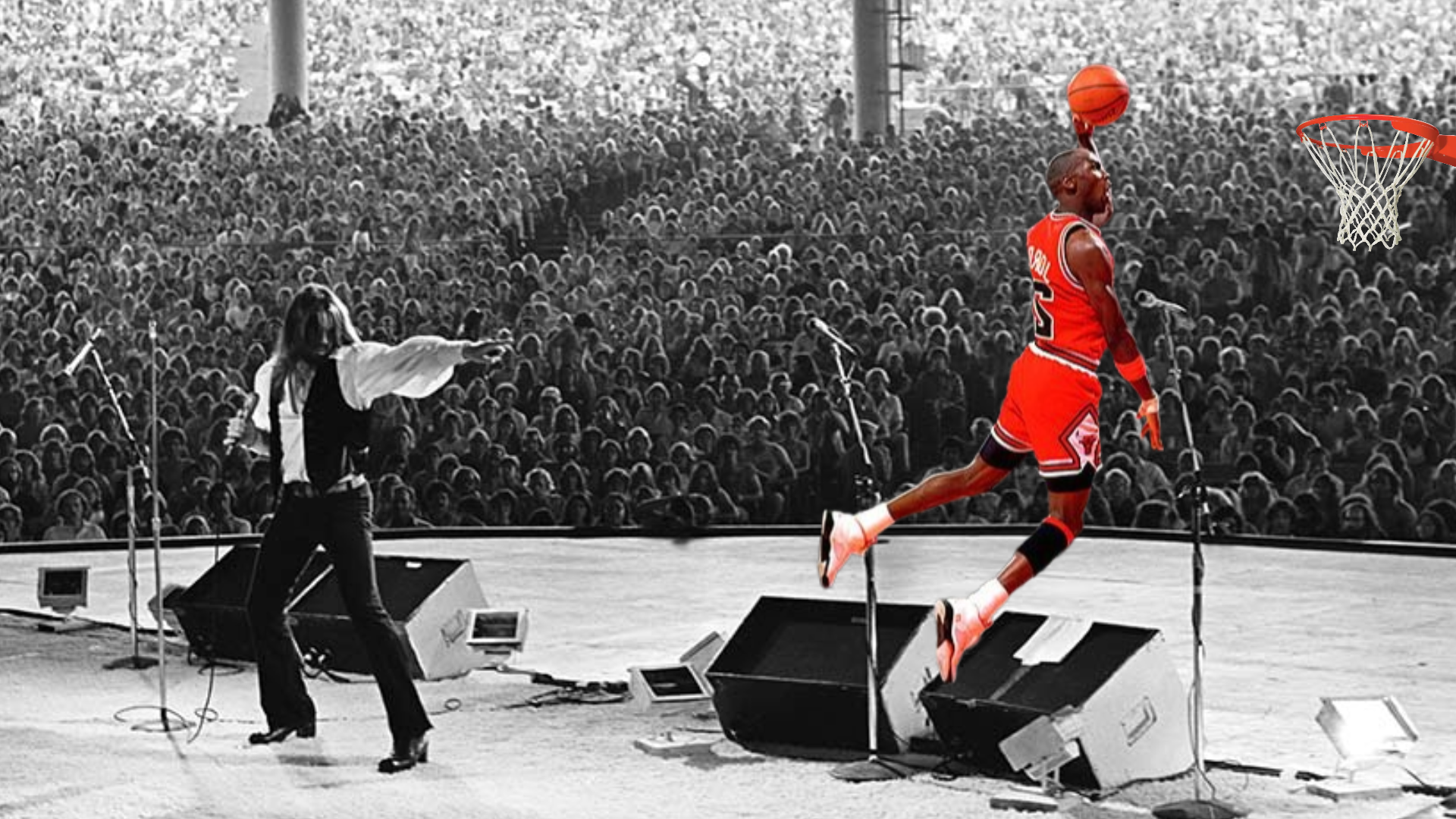
It looks like editing, but it’s actually physics. And the theory is simple: Michael Jordan is perfect motion scored in 4/4, and Seger writes in the key of American inevitability. Put them together and you get what we like to call here at Babble Of Tower ‘devotional kinetics’—
—a moving picture of work ethic transforming into flight.
THE DISCOVERY (MADE UNDER THE INFLUENCE OF BOURBON)
So, this was discovered by accident. Mid-week work trip, the middle of Illinois, at the one steakhouse everyone agrees on. Down a short elevator ride into a lower level of a multi-use office building, opened up into a kind of subterranean time capsule: dark oak, brass fixtures, cheese-grater-patterned carpeting that has seen generations of every imaginable job promotion. The air hums with broiled fat, nostalgia, and whatever song is always playing on the hi-fi that hasn’t been unplugged since 1978. Every booth has its shrine—celebrity headshots curling in their frames, sports memorabilia fading under varnish, linen napkins folded like church bulletins. The bartender wears a tie clip shaped like a golf club. The lights are low enough to either throw back drinks and/or confess your sins.
A few of us lingered after the plates cleared and the staff was resetting the dining room for the next evening—creative team, road-tired, whiskey-loose—sitting around a baby grand piano that hasn’t seen regular play since Reagan was in office. The sequence of events is still fuzzy, but it was one of those ideas that crawls out of your cocktail, somewhere between the third round and the end of small talk, just the way dumb little bar crawl miracles always do. Mid-laugh, off-hand.
Someone pulled up a Jordan highlight reel on their phone. Another started humming Against The Wind. Then, it happened.
And what was that that happened, exactly?
Somewhere between verse and crossover, reality glitched. Pull-up matched the downbeat. The spin checked the bassline. The jumpshot landed exactly where the chorus broke. And for a second the whole room felt synced—bar chatter, kitchen hiss, the clink of ice in a rocks glass. All of it keeping time.
What was most striking at that moment, and in my semi-drunken state, was that this didn’t feel like coincidence. It felt like excavation. It felt as if this pairing had always existed somewhere beneath that basement steakhouse linoleum and the oak panelling, living quietly until someone stumbled across it and pressed ‘play’.
Because, my unsubscribed Analog Masses, you, too, can line up any Michael Jordan highlight reel over any Bob Seger song, and those two disparate things will lock together like pistons in prayer. No tricks, no edits. Just America’s rhythm, perfectly looped.
THE RECIPE (BY SOMEONE WHO FAILED BOTH MATH & PHYS ED)
Of course, once you witness a Midwest miracle such as this, the only logical next step is to systematize it—and poorly. So…
Pick a Jordan. Again, any era: North Carolina glide, rookie flash, Bad Boys gauntlet, six-ring cosmic harmony.
Pick a Seger. Against The Wind, Night Moves, Like A Rock, Still the Same, Roll Me Away, Hollywood Nights, Turn the Page.
Align the first dribble to the downbeat.
Do not adjust further. Let the universe do the rest.
And, again, what’s going to happen next will not be coincidence. Jordan’s footwork subdivides time exactly the way Seger’s rhythm sections do—heel-toe, drive-release. Human metronome. The bodies will start preaching in triplets.
THE FORMULA (MAKING THIS UP AS I GO)
Naturally, we after-hours, barstool, Uber-calling scientists demanded theoretical principles, so what follows is equal parts drunk physics and whiskey logic:
BPM & FOOTWORK: Seger lives around that 100–120 BPM heart rate; Jordan’s footwork cycles in two- and four-step patterns. The gather step lands on the bar line; the hang occupies the sustained chord; the release crushes the downbeat.
LYRIC FUNCTION: Seger writes refrains as earned conclusions, so they pay off verses that grind forward. Jordan builds possessions the same way: probe, pullback, explode. Chorus = lift-off.
Timbre vs. Texture: That signature rasp in Seger’s voice is equivalent to the squeak of sneakers on a hard pivot or the thump of leather hide against a palm. All are honest noises—that’s just good, hard work made audible.
Narrative Shape: Each song is about going—on the road, back in time, through the storm. Each highlight is about getting there—through bodies, through doubt, through physics. The ‘there’ is never a place; it’s a moment that validates the grind.
And BOOM!—devotional kinetics—the conversion of repetition into revelation.
THE CASE STUDIES (ZERO METHODOLOGY, MAXIMUM CONFIDENCE)
Having convinced ourselves the math mathed, we went looking for evidence. Turns out there’s actually plenty:
1) AGAINST THE WIND × THE FLU GAME (1997)
Tempo just below sprint. Verses that lean forward. A chorus that feels like air getting thin. Overlay Jordan wiping his face, then shouldering Utah anyway. When the line hits—“I’m older now but still runnin’ against the wind”—the camera finds him on defense, bent at the waist, mouth open, hands alive. Straight gospel.
2) NIGHT MOVES × THE SHRUG GAME (1992)
Mid-tempo nostalgia with a rim-shot heartbeat. Jordan drops three after three, then performs that stunned little shrug like someone who just realized what his hands are capable of. “Workin’ on our night moves”—and cut to a sideline replay with the crowd becoming a storm cloud. Myth actin’ casual.
3) LIKE A ROCK × THE LAST SHOT (1998)
Yes, the Chevy-branded anthem. But listen past the ads. The verses are quiet steel; chorus, granite. Over Bryon Russell, time dilates. Jordan gathers, holds the whole building in his palm, and then—downbeat—follows through. “Like a rock”, and the net becomes a prayer shawl. Pure American cathedral nave.
4) TURN THE PAGE × 63 ON THE CELTICS (1986)
A touring ballad about repetition and lights in your eyes, a saxophone that sounds like a bus brake. Switch to Boston Garden grain; watch a 23-year-old carve a dynasty with hang-time and shoulder fakes. “Most times you can’t hear ’em talk”, but the Garden does and it sounds like fear. The early pilgrimage gets the worm.
5) STILL THE SAME × EVERY RETURN FROM RETIREMENT
The verse is poker-table RBF and the chorus a smirk. Cut in the No. 45 days, the spring legs, the mid-range shoulder lean. “You’re still the same”—and you see why the league could only evolve around him, not away from him. Gravity doesn’t retire.
THE PLAYBOOK (BASED MOSTLY ON SETTING APPLE MUSIC TO RANDOM)
Now, for any completists and all the skeptics, here’s your at-home, do-it-yourself Devotional Kinetics Starter Pack.
The Shot over Ehlo (’89) ↔︎ “Hollywood Nights” (Too fast? Exactly—makes the cut feel like a chase scene)
Free-throw line dunk (’88) ↔︎ “Roll Me Away” (Open-road pre-chorus to suspension-bridge hang-time)
Double-nickel at MSG (’95) ↔︎ “Still the Same” (Smile you can hear)
Any fourth-quarter closeout ↔︎ “Like a Rock” (Inevitable chorus, inevitable dagger)
No need to get cute. Let the backbeats do the editing.
THE SHARED MYTH (ALL OUR DADS ARE CRYING SOMEWHERE)
If it feels uncanny, that’s because it is. The sync works for the same reason every great American story does. It’s built on faith in labor. Bob Seger’s catalog is chock full of blue-collar transcendence. Songs about mileage and memory where the chorus arrives like a horizon you’ve been chasing. Michael Jordan playmaking is the visual corollary—a man who metabolized work into spectacle so completely that all that effort looked effortless.
Or: Seger sings the road and Jordan is the road. Both stories are rust-belt romanticism: The refrain is the rep, the rep is the refrain.
THE CULTURAL MIRROR (UNQUALIFIED OPINION)
If you zoom out even more, this theory of synchronicity stops being about Jordan or Seger, and becomes about us. This isn’t an editing coincidence, it’s a map of American belief systems, the myth of the self-made man. It’s the worker who out-hustles the system, turns labor into art, and that art into legacy.
Seger and Jordan both sold us the same gospel:
If you work hard enough, your body of work becomes an idea. They both understood that greatness in America has to look like suffering beautifully. Seger growled it. Jordan embodied it. Both were haunted by what came after, however. The loneliness of being the best at something no one else can understand.
When Seger sings, “Wish I didn’t know now what I didn’t know then”, you can hear Jordan in the background taking pop-shots.
It’s not regret, just the cost of clarity.
THE REVELATION (DON’T EXPECT TOO MUCH)
Which brings us back to that steakhouse grand piano, a muted screen, and that tinny, mobile phone speaker…
And, OK, OK, on the surface, it’s a parlor trick; a fun bar theory. But underneath, if you’re willing to consider it, this is actually a kind of cultural x-ray. It’s proof that two icons from different mediums and decades were carrying the same national dream on their backs. Michael Jordan and Bob Seger aren’t just examples of excellence, they’re templates for how America wants excellence to look.
Not effortless—earned.
Not glamorous—gritty.
Not divine—deserved.
Seger’s voice is the sound of a factory worker clocked in after the whistle. Jordan’s body is the movement of a man who refuses to clock out. Both are stories about what happens when ordinary discipline becomes supernatural ability.
And that’s the real heart of this. When Seger hits the downbeat and Jordan leaves the floor, the line between labor and art disappears. The chorus and the dunk are saying the same thing. ‘I worked for this, and the work became me.’ That’s not just American nostalgia, that’s the country’s most seductive lie. That if you grind long enough, you can turn pain into transcendence and everyone will rally around you.
It’s also the most hopeful version of that lie, because we still believe in effort as meaning.
Seger sings about roads because he knows there’s no destination. Jordan chased perfection because he knew it couldn’t be caught. They’re both haunted by the same paradox. Motion as purpose, purpose as exhaustion. That’s why the sync hits so hard. It’s actually not even nostalgia, it’s recognition. It’s seeing the idea of America—sweat, swagger, sacrifice, soundtrack—lined up on the same timeline and finding it… In rhythm.
Because maybe that’s all the American Dream ever promised: That if you keep moving, keep playing, keep working, there will come a moment—brief, cinematic, weightless—when the song and the body meet, and for one bar, it will all make sense.
The chorus fades, the lights come up, and you go back to work.
#DevotionalKinetics #AppliedBarroomScience #RustBeltMetaphysics #DadRockAsData #TheologyOfHangTime #SynchronicityStudiesDept #TheInstituteForUnnecessaryCorrelation #OverthinkOrDieTrying